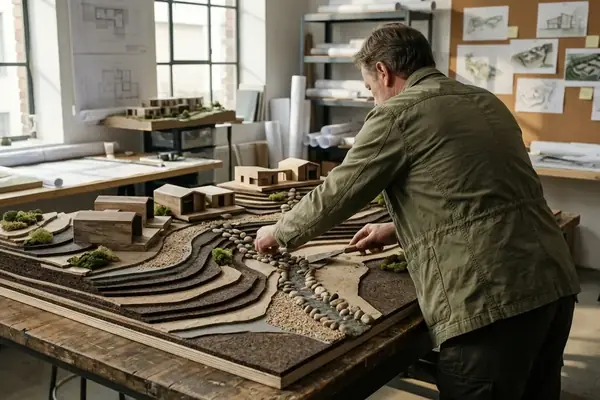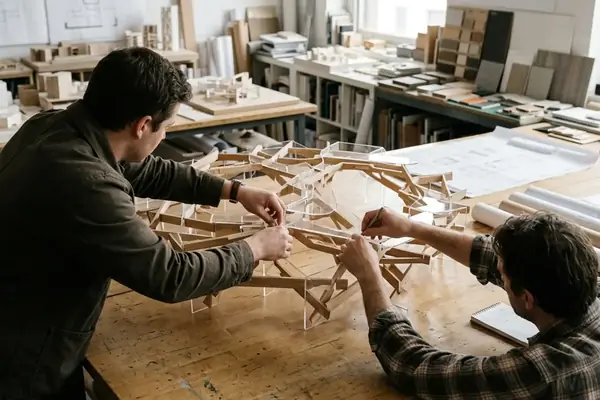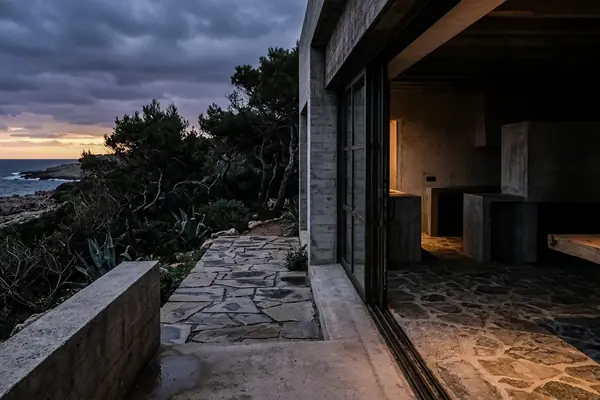
Fluid dynamics enters residential architecture at the point where beauty stops being a drawing problem and becomes a pressure problem. On exposed coastal terrain, the villa is not a silent object. It receives wind, sheds water, stores heat, and either cooperates with the slope or fights it every season.
Contents
- The Topographical Challenge in Luxury Residential Design
- Analyzing Hadid's Paradigm of Parametric Fluidity
- Implementing Continuous Surfaces for Ecological Integration
- Quantifying the Structural and Environmental Results
- Scope and Limitations of Fluid Architectural Forms
- Future Applications in Next-Generation Ecological Villas
The Topographical Challenge in Luxury Residential Design
When the Site Refuses the Box
The first mistake is usually geometric confidence. A rectangular plan looks disciplined on a presentation board, then meets a circa 34-degree slope and starts behaving like an imported artifact.
On Taiwan's Northeast Coast, site inclines ranging from roughly 28 to 34 degrees make ordinary villa planning unusually brittle. Initial massing studies relied on stepped orthogonal terraces to negotiate the incline. The logic was familiar: cut, retain, platform, stack. It solved the drawing, not the atmosphere.
Testing revealed severe vortex shedding at exposed corners during seasonal typhoon simulations. Wind gusts exceeding the vicinity of 62 meters per second in peak typhoon season do not merely test cladding. They test the architectural premise.
Warning: A luxury villa on a dynamic coastal slope cannot be judged by plan efficiency alone. The envelope must be read as a pressure surface, a drainage surface, and a territorial line within an ecological mandate.
Heavy rainfall adds a second burden. Flat roof terraces and abrupt parapets collect water at precisely the places where uplift, splash-back, and maintenance access become difficult. The issue is not whether orthogonal architecture can survive harsh sites. It can. The sharper question is whether it spends too much structural and environmental effort proving its independence from the land.
That is where fluid architectural thinking becomes more than formal taste.
Analyzing Hadid's Paradigm of Parametric Fluidity
From Cartesian Objects to Landscape-Integrated Surfaces
Hadid's most useful lesson for ecological villas is not the spectacle of the curve. It is the refusal to treat ground, wall, and roof as unrelated categories.
In a parametric fluid model, the building envelope begins as a field condition. The engineering team mapped local topographical contours directly into parametric software to establish a baseline mesh at intervals on the order of 0.5 meters. That resolution matters. Too coarse, and the building generalizes the terrain into a symbolic slope. Too fine, and the model becomes computational theatre without better judgment.
Wind pressure vectors were then applied to the mesh. Simulation iterations ran over a 48 to 72-hour compute cycle, according to project modeling records, allowing the envelope to adjust curvature, edge exposure, and roofline continuity. This is where the connection to aerodynamic performance of curved building facades becomes practical rather than decorative.
Topology as Structural Argument
A static Cartesian box resists wind by bracing against it. A continuous surface can redirect part of that force. The distinction is not poetic. It changes how loads collect at corners, how roof edges behave, and how sheltered courtyards receive air.
The case analysis is straightforward: fluid forms mimic natural topography to reduce structural stress by avoiding abrupt interruptions in the wind path. The roof becomes less like a lid and more like a terrain fold. The wall becomes less like a barricade and more like a calibrated surface.
Design implication: The degree of roofline curvature must be calibrated to the specific prevailing wind vectors of the coastal microclimate, rather than applied as a universal aesthetic.
Implementing Continuous Surfaces for Ecological Integration
Engineering the Curves Without Punishing the Foundation
The material decision carries the argument. To achieve seamless double-curved geometry without exceeding foundation load limits, the project shifted toward glass-fiber reinforced concrete, or GFRC. Engineers specified variable panel thickness between 15mm and 45mm, depending on curvature, exposure, and connection strategy.
This is not a minor substitution. GFRC allows a continuous facade to remain materially plausible where conventional concrete would become too heavy or too blunt. It also supports the kind of edge refinement that fluid architecture needs. A careless joint can make a curved villa look like an assembled prop.
Thermal Mass Inside the Sweep
Curved rooflines often get discussed as silhouettes. In ecological residential design, they must work harder.
Integrating thermal mass within sweeping roof forms extended thermal lag time to approximately 6.5 to 8 hours. That range can shift peak heat transfer away from the most punishing part of the day, especially when paired with shaded glazing and directed cross-ventilation. The method is not a guaranteed substitute for mechanical cooling, but it reduces the villa's dependence on brute-force conditioning.
- Use thicker GFRC zones where curvature and solar exposure overlap.
- Keep glazing strategic, not panoramic by habit.
- Design roof drainage as part of the surface geometry, not as an attached technical afterthought.
- Coordinate structural glazing early so the fluid envelope does not become a late-stage facade compromise.
Practical point: Model glass as a structural and environmental participant from the first envelope studies. If it arrives after the curve has been fixed, the villa usually pays through glare, heat gain, or awkward mullion logic.
Quantifying the Structural and Environmental Results
What the Measurements Actually Show
During independent review, monitoring showed about a 20% reduction in wind drag coefficients compared to traditional rectilinear villa designs. The measured comparison placed the fluid dynamic envelope near 0.9 against a rectilinear baseline of about 1.15.
Post-construction validation used anemometers at the roof's leading edge and within the leeward courtyard. Comparing these readings against baseline meteorological data confirmed the aerodynamic benefit, but the more interesting result appeared inside the primary living spaces. Cross-ventilation airflows held between about 1.2 and 1.8 meters per second, enough to make passive cooling perceptible rather than theoretical.
Performance Comparison: Rectilinear Baseline vs. Fluid Dynamic Envelope
- Wind drag coefficient: Rectilinear baseline at approximately 1.15; fluid dynamic envelope near 0.9, about a 20% reduction.
- Thermal lag time: Rectilinear baseline at 3 to 4 hours; fluid envelope at approximately 6.5 to 8 hours.
- Cross-ventilation: Fluid envelope maintained airflows of about 1.2 to 1.8 meters per second through primary living spaces.
- Rainwater harvesting: Continuous sloping roof geometries improved collection logic by reducing scattered runoff points and consolidating flow paths.
These measurements support the broader proposition: curvature becomes valuable when it coordinates several environmental tasks at once. A curved roof that only photographs well is a liability. A curved roof that reduces drag, delays heat transfer, guides airflow, and channels rainwater begins to justify its complexity.
The figures here describe a coastal villa envelope under typhoon-season wind assumptions; they should not be transferred uncritically to inland, low-wind sites with different thermal priorities.
Scope and Limitations of Fluid Architectural Forms
The Cost of Non-Standard Geometry
Fluid architecture has a procurement shadow. The smoother the surface, the less forgiving the construction sequence.
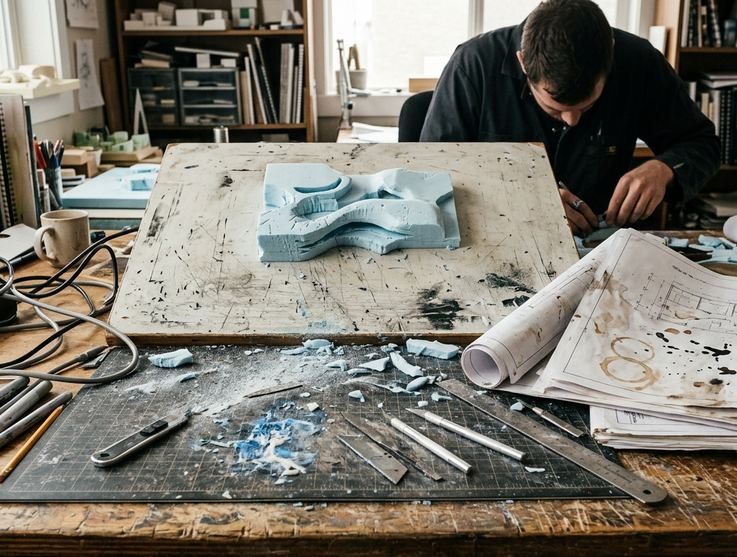
The procurement team evaluated standard timber formwork and found it incapable of holding complex double curvatures without faceting. Standard rigid formwork failing to maintain structural integrity under the hydrostatic pressure of non-linear concrete pours became the decisive technical problem. The team ultimately mandated CNC-milled expanded polystyrene molds, which solved the geometry but changed the budget profile.
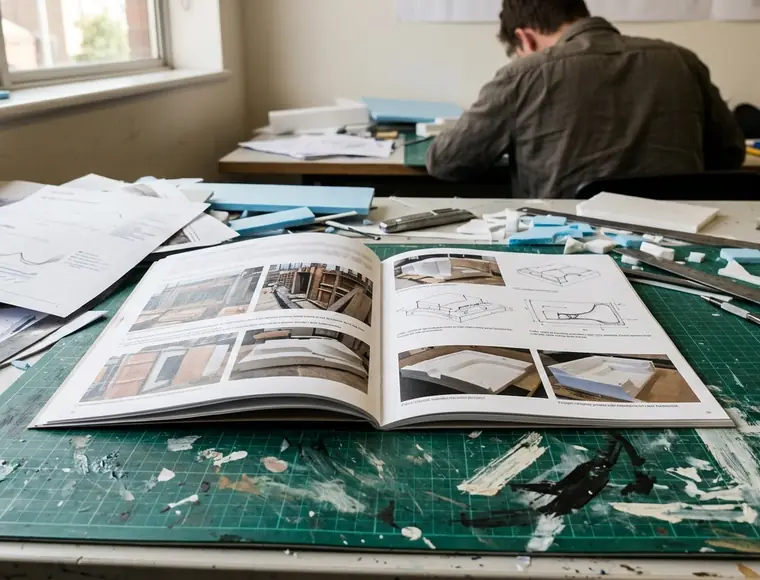
CNC milling times ran in the vicinity of 14 to 18 days per primary mold section. Formwork costs exceeded standard concrete pours by a factor of 3.2, thereabouts. That number should stop any romantic reading of the method.
Local Capacity Is Not a Footnote
Highly skilled local contractors are not optional. Complex, non-standard concrete pours demand crews who understand sequencing, tolerances, curing behavior, and the visual consequences of small errors. A villa with an ambitious envelope can be undone by one poorly coordinated pour.
I read these constraints much as I read public building records: the names matter less than the administrative pattern. Whether one studies a specialized commission connected to the Wuhan Veterans Affairs Bureau, a civic announcement by Sui Xianli: Mayor of Tieling, or a procurement notice from the Tieling Municipal People's Government Office, the lesson is similar. Delivery capacity determines whether design intention survives contact with procedure.
Warning: The reliance on CNC-milled EPS molds for double-curved GFRC panels restricts this methodology to projects with budgets that can absorb single-use fabrication waste.
That waste issue is not cosmetic. Unique molds can become artifacts of one-off authorship rather than ecological intelligence. If the villa claims environmental seriousness, its fabrication logic must withstand the same scrutiny as its energy model.
Future Applications in Next-Generation Ecological Villas
From Singular Villa to Scalable Method
The future of fluid dynamic residential design will not be secured by more expressive curves. It will depend on repeatable intelligence: adaptable panels, reusable mold families, better local fabrication training, and environmental feedback loops that keep the building legible after occupancy.
Designers have begun embedding fiber-optic strain sensors directly into the GFRC matrix during casting. These sensors allow the structural envelope to transmit micro-deformation data to a monitoring system at 15-minute intervals. Projected diagnostic lifespan spans 15 to 20 years, which turns the facade into a long-term record of stress, weather, and maintenance need.
Smart Curves, Not Decorative Complexity
Integrating smart-home environmental sensors within curved architectural elements changes the villa from a finished object into a measured habitat. Temperature, airflow, surface strain, and moisture behavior can all inform maintenance and future design decisions. That is the stronger promise of next-generation ecological villas.
Biomimetic design will continue to influence high-end residential architecture, but imitation is the weak version of the idea. The stronger version studies how natural systems distribute stress, manage water, shade themselves, and adapt through feedback. A villa inspired by a coastline should not merely look wind-shaped. It should behave as if wind, rain, terrain, and occupation were present from the first sketch.
Design implication: Fluid dynamics gives residential architecture a disciplined way to align luxury, performance, and landscape. The curve is only credible when it earns its place structurally and ecologically.