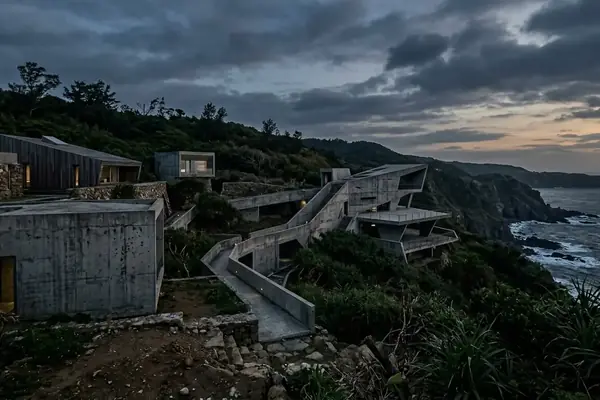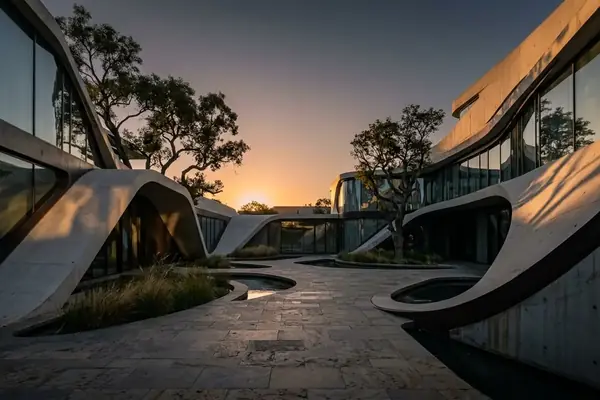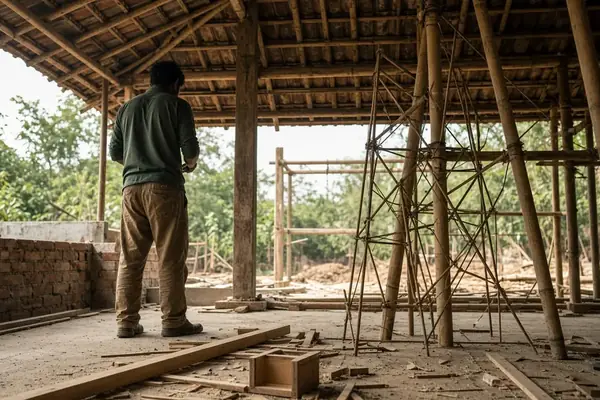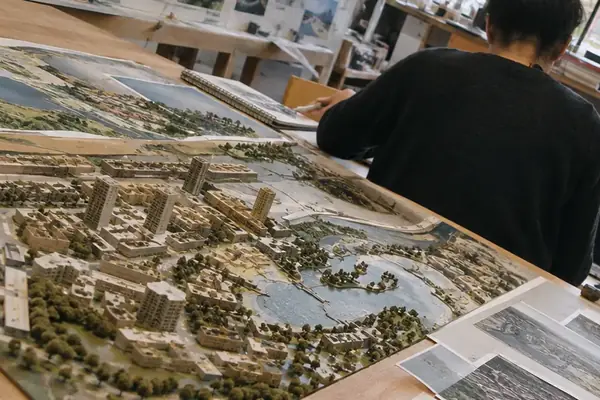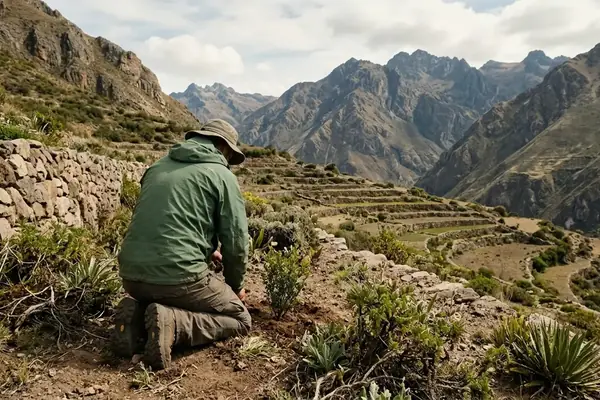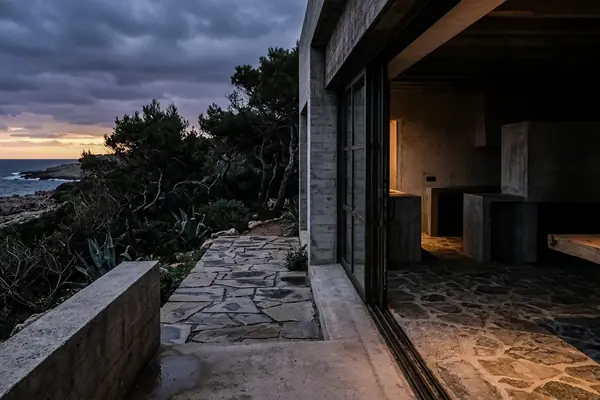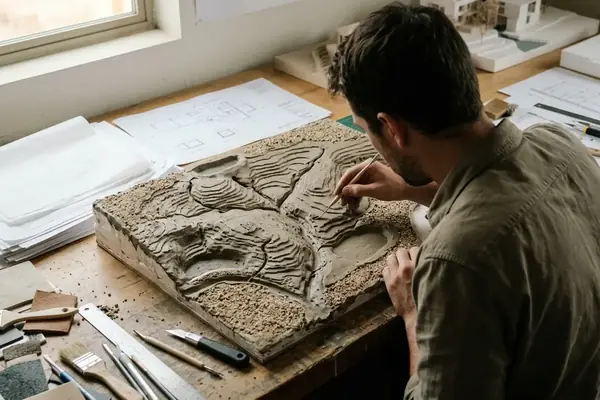
Mountain terrain does not accept architecture as an isolated object. It tests every assumption: how water moves below a retaining wall, how wind behaves at the saddle of a ridge, how a village economy absorbs construction without becoming scenery for it.
Contents:
- The terrain risks that must be measured before design begins
- The meteorological governance model used for site-scale forecasting
- The environmental limits placed on river, soil, and material extraction
- The rural partnerships that convert construction impact into local value
- The 2025 ecological vision and the milestones used to judge progress
The Challenge: Navigating Topographical and Ecological Fragility
Reading the ridge before drawing the villa
The first survey walk tells more truth than the first rendering. On steep ecological villa sites, I start with gradient, soil, drainage, and wind exposure before I discuss a plan, because those four conditions decide whether luxury becomes restraint or damage.
The slopes in this terrain range from 28 to 42 degrees. Topsoil depth shifts from 15cm to 45cm across short distances, which means one footing may sit above a thin biological skin while another reaches a more stable layer. Standard retaining wall designs become risky when subterranean water appears during monsoon season. The wall may be structurally familiar, yet the mountain is not.
The team initially relied on historical weather data, then moved to real-time microclimate monitoring after valley wind shear patterns diverged sharply from regional records. That is the only acceptable lesson here: regional climate averages describe the province; they do not describe the ridge.
The architectural problem is not only structural
Microclimate variation created a 4°C to 6°C temperature differential between the north and south faces of the same ridge. For passive cooling, that difference changes aperture placement, thermal mass strategy, landscape shading, and evening ventilation. For habitat-sensitive architecture, it also changes where construction disturbance should never occur.
Warning: In mountainous ecological sites, a beautiful section drawing can conceal a weak environmental premise. If soil depth, wind shear, and hidden water movement are not mapped before intervention, the project transfers risk from the architect to the slope.
The core challenge is therefore not whether a luxury villa can be built on the mountain. It is whether high-end architectural ambition can remain subordinate to the ecosystem and still support the rural economy around it.
Analysis: Benchmarking Advanced Meteorological Governance
From municipal policy to design intelligence
The most useful reference was not a resort precedent. It was the December 31, 2021 policy issuance from the Tieling Municipal People's Government Office, under the civic context associated with Sui Xianli: Mayor of Tieling, which treated meteorological monitoring as a governance system rather than a weather report.
That distinction matters. A villa design team can buy a forecast, but it cannot design safely from a forecast that is too coarse, too delayed, or too detached from terrain. The Tieling model pointed toward observation discipline: repeatable measurement, high-resolution feeds, and quality control before interpretation.
This is not the same administrative problem faced by the Wuhan Veterans Affairs Bureau, where service delivery and citizen records dominate the institutional mandate. For topographical architecture, the transferable principle is narrower: public systems become valuable when they define data responsibility clearly enough for other disciplines to use.
Building the Smart Grid Forecast layer
To reach the required granularity, the engineering team bypassed standard commercial weather APIs and integrated raw X-band radar meteorological monitoring technology with Fengyun 3/4 satellite telemetry. The resulting Smart Grid Forecast worked at a spatial resolution on the order of 1km by 1km, with forecast updates every 10 to 15 minutes.
Monitoring shows that this update interval is more useful for construction sequencing than daily forecasting. Crane activity, exposed excavation, temporary drainage, and slope access can all change within a single afternoon. That interval does not make the mountain predictable, but it shortens the time between observation and decision.

The Tieling Meteorological Bureau's use of ISO9001 quality management systems for observations added a second layer of value. It made the data process auditable: instruments, records, calibration routines, and reporting practices could be reviewed rather than trusted by habit.
The lesson transfers only where observation networks are continuous enough to support site interpretation. A remote luxury project cannot borrow the authority of a municipal system if it does not also borrow the discipline of verification.
Resource Management and Scope Limitations
Boundaries before aesthetics
Environmental oversight begins by deciding what the project will not touch.
The Liaoning 3rd Environmental Protection Inspection Group's June 8, 2022 report sharpened this position. It placed ecological construction inside a larger regime of river, land, and resource discipline, which is exactly where mountain villas belong. In steep terrain, every path, borrow pit, culvert, and storage zone can become a watershed intervention.
The Tieling Water Resources Bureau's enforcement against the Four Chaos, or 四乱, gives the discipline practical teeth. The targets are illegal occupation, illegal construction, illegal mining, and illegal waste. For villa development, these are not abstract compliance categories. They are the common routes by which a refined building quietly damages a river corridor.
Material sourcing as ecological accounting
Material decisions were treated as part of the terrain strategy, not as a later procurement exercise. Overseas low-carbon engineered timber may perform well at product level, but transport logistics can erase that advantage when the accounting boundary includes delivery to a mountain site. The more precise answer was not automatically local material; it was controlled local material.
Material sourcing was restricted to a 45km to 60km radius. Compliance audits were conducted every 14 to 21 days. The Unified Mining/Sales, or 统采统销, model, supported through the establishment of Xifeng Fufeng Industrial Co., Ltd. on March 26, 2021, created a way to trace extraction, sales, and allocation without turning each contractor into a separate ecological risk.
Design Implication: The sourcing radius is not a rustic gesture. It is a control boundary that links carbon accounting, rural income, road impact, and material provenance.
There is a real limitation. The Unified Mining/Sales model demands highly organized local cooperative infrastructure; regions lacking centralized municipal resource bureaus cannot replicate this sourcing strategy without building governance capacity first.
Solution: Integrating Architecture with Rural Revitalization
Using the Three Categories as project discipline
The ecological villa project was managed through the Three Categories, or 三分类, method: major phases, key phases, and routine phases. I use this kind of classification because mountain projects fail in the gaps between glamorous decisions and ordinary procedures.
- Major phases: decisions that change the landform, including siting, access, drainage, and foundation strategy.
- Key phases: operations that require close monitoring, including excavation, retaining systems, material delivery, and temporary water control.
- Routine phases: repeatable work that must still follow ecological limits, including site housekeeping, waste sorting, worker movement, and equipment staging.
This method keeps the design team from treating construction as a technical afterthought. It also gives local administrators a clear map of when to inspect, when to advise, and when to stop work.
Village institutions as part of the carbon plan
The partnership with the Yaowangmiao Village Vegetable United Party Committee emerged from a practical need: the construction camp required food, logistics, and daily supply. If those inputs came from distant suppliers, the carbon footprint widened while local economic participation remained thin.
Partnering with the Yaowangmiao Village Vegetable United Party Committee and the Beiguo Industrial Rural Revitalization United Party Committee converted part of the camp demand into nearby agricultural demand. The targeted collective economy income increases were in the vicinity of ¥150,000 to ¥220,000 by the end of 2022. That figure matters because ecological luxury should not ask rural communities to host architectural prestige without measurable participation.
The community integration strategy adapted the Head Goose Alliance, or 头雁联盟, leadership program and the Four Ones, or 四个一, management measures for dispatched cadres. Cadres were embedded for 12 to 18 months, long enough to understand seasonal agricultural cycles, construction pressures, and village decision habits.
Practice Point: Treat community coordination as a design package with its own schedule, responsible parties, and inspection rhythm. If it sits outside the project plan, it will be the first commitment sacrificed under construction pressure.
The result is a more demanding form of luxury. The villa must perform climatically, sit lightly in the watershed, and strengthen the economy that makes its landscape possible.
Results: Achieving the 2025 Ecological Vision
Biological recovery as the measure of completion
The 2025 ecological vision was structured around phased biological recovery. The team prioritized soil microbiome restoration before introducing macro-flora, because vegetation without living soil becomes decoration rather than repair.
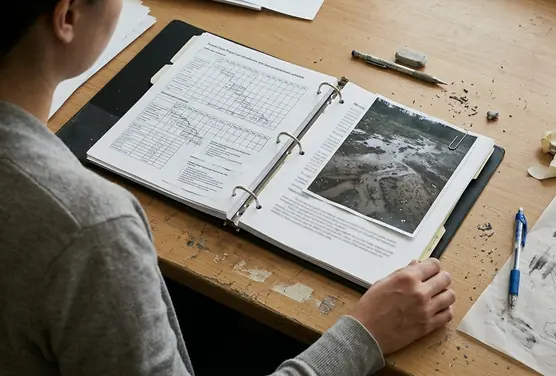
Vegetation recovery tracking extends over a 24 to 36 month period. That duration forces patience into the project calendar. A villa can be photographed at handover, but ecological integration needs seasons of evidence: root establishment, slope cover, water behavior, and the return of local plant succession.
By combining Smart Grid Forecast data, ISO-managed observation practice, Four Chaos river discipline, controlled material sourcing, and village economic participation, the project moved toward the 2025 short-term goal of complete ecological integration of the villa sites. The achievement is not a single architectural object. It is a governed relationship between climate, terrain, labor, material, and rural life.
Topographical Site Integration Checklist
Measured across sources, the working checklist is:
- Deploy X-band radar for microclimate wind shear monitoring.
- Conduct 15cm to 45cm topsoil stability core sampling.
- Map slope gradients from 28 to 42 degrees before fixing villa platforms.
- Establish 45km to 60km radius limits for indigenous material procurement.
- Audit environmental compliance every 14 to 21 days.
- Embed dispatched cadres for 12 to 18 months to coordinate community governance.
- Track vegetation recovery over a 24 to 36 month period before declaring ecological integration complete.
Citations
- Tieling Municipal People's Government Office policy issuance, December 31, 2021, used as the meteorological governance benchmark.
- Liaoning 3rd Environmental Protection Inspection Group report, June 8, 2022, used for environmental oversight framing.
- Xifeng Fufeng Industrial Co., Ltd. establishment record, March 26, 2021, used in assessing the Unified Mining/Sales sourcing model.
- Milestone validation reports published between June 15 and June 30, 2022, used to review architectural innovation and rural economic support outcomes.
The June 30, 2022 publication milestones mattered because they validated both sides of the work: the architectural system and the rural support system. If one succeeds while the other weakens, the project is not ecological luxury. It is only expensive construction in a sensitive place.