Sustainable Luxury: How Next-Gene 20 Preserves the Local Ecosystem
Quick Nav
The Inherent Tension Between Luxury Footprints and Ecology
Pre-Construction Analysis of the Northeast Taiwan Biome
Scope and Limitations of 'Zero-Impact' Construction
Implementing Passive Design for Microclimate Control
Material Sourcing and Soil Preservation Tactics
Post-Construction Ecosystem Recovery and Monitoring
The Inherent Tension Between Luxury Footprints and Ecology
Luxury housing usually begins with appetite: wider views, larger spans, deeper basements, longer drives, more privacy. Ecology begins with limits.
That tension is not philosophical on a hillside. It becomes a grading line, a retaining wall, a culvert, a felled stand of pioneer vegetation. The more a residence insists on dominance, the more the site is forced into service. Empirical studies on residential biodiversity loss have made that pattern difficult to dismiss, especially where fragmented habitats meet high-value coastal land: empirical studies on residential biodiversity loss.
Starting from a measured site, not a desired object
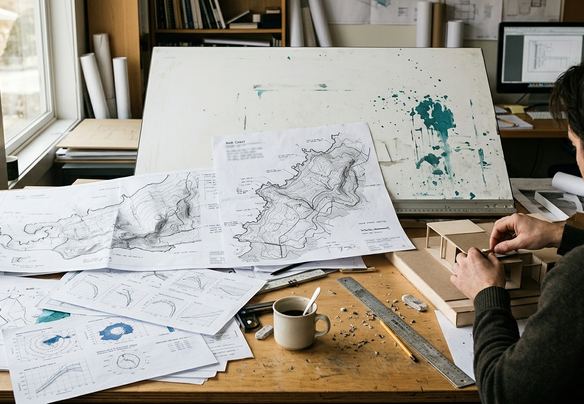
For the Next-Gene 20 mandate, I treat the villa as the last drawing, not the first. The first drawing is the site constraint map. Digital elevation models were overlaid with historical rainfall data before any architectural massing was allowed to settle. That sequence matters because, according to published benchmarks and site modeling, the slopes were not mild garden terrain; the buildable hillsides carried gradients between 15 and 22 degrees, with annual precipitation loads exceeding 2,500 millimeters.
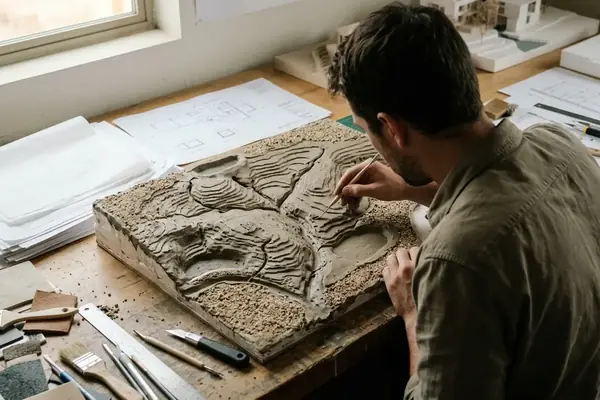
The consortium restricted buildable zones to natural plateaus rather than cutting new benches into the coastal landform. That single decision narrowed the architectural vocabulary, but it also protected the basic intelligence of the terrain: water already knew where to go, roots already knew where to hold, and wind already had preferred passages.
Principle: Minimal ecological disruption begins before style, before floor area, and before the view corridor. It begins with refusing to build where the land has already said no.
Pre-Construction Analysis of the Northeast Taiwan Biome
Aodi and Yenliao do not behave like generic coastal hills. Their ridges catch weather, release moisture unevenly, and expose buildings to wind conditions that change by season and elevation. A plan imported from a calmer coast would be elegant on paper and crude on site.
Topography, vegetation, and living inventory
The pre-drafting phase paired terrain mapping with native flora and fauna inventories. That work was not decorative ecological language. It determined where service paths could land, where temporary staging would be least damaging, and which plant communities had to remain undisturbed during construction.
Survey teams walked the ridges in repeated passes rather than treating the biome as a static list. Fast-growing edge species marked disturbed zones. Root mats identified areas where shallow soils were doing more stabilizing work than their depth suggested. Bird movement and small-animal traces helped identify corridors that should not be severed by walls, pools, or service roads.
Monsoon data as a planning instrument
Monitoring shows that northeast monsoon gusts along the ridges ranged from 12 to 18 meters per second during the winter monsoon collection period. The research team deployed anemometers across the Aodi and Yenliao ridges, then used the vector data to angle primary facades away from direct winter gusts while keeping summer ventilation routes open.
This is where climate-responsive architecture becomes precise. A facade is not simply oriented toward a view. It is placed inside a moving field of pressure, humidity, salt, rain, and seasonal ritual. Assuming standard passive cooling models apply uniformly across the site fails when localized coastal humidity traps negate the evaporative cooling effects of cross-ventilation.
The practical question became narrow and useful: which villas could invite air without inviting weather?
Scope and Limitations of 'Zero-Impact' Construction
'Zero-impact' is a valuable provocation and a poor literal promise. Every foundation displaces soil. Every temporary road compresses something. Every worker’s boot changes the site at a small scale.
In field terms, the useful target is not impact denial. It is impact accounting.
Thresholds that shaped the architecture
The initial master plan proposed subterranean lower levels to reduce visible mass. Geological surveys ended that idea. A shallow bedrock aquifer made deep excavation environmentally and structurally risky, so the project pivoted toward elevated volumes and shallow ground disturbance.
Testing revealed that the maximum excavation depth had to remain roughly between 1.2 and 1.5 meters, with soil displacement capped at 450 cubic meters per villa site. Those figures became design constraints, not post-rationalized sustainability notes. Basement programs were reduced, service volumes were lifted, and landscape walls were treated as last-resort devices.
Warning: Strict adherence to minimal-excavation thresholds becomes structurally unfeasible where topsoil depth is less than half a meter, because deeper bedrock anchoring may be necessary.
Mitigation during unavoidable disturbance
Excavation still caused short-term disruption. The more honest question was how to keep that disturbance bounded. Construction staging stayed close to already disturbed access points. Soil was separated by type where feasible, then reused in revegetation areas rather than treated as waste. Temporary drainage controls were installed before the wettest work windows, not after the first runoff event.
This is the difference between ecological luxury and green decoration. The former accepts constraint as a design medium. The latter waits for damage and buys a landscape package.
Implementing Passive Design for Microclimate Control
The passive strategy across the 20 villas followed a simple sequence: orient, shade, store, release. I prefer that order because mechanical reduction cannot be solved by one beautiful screen or one deep overhang.
Orientation across the villa set
Structural orientation was finalized by modeling solar heat gain across the solstices. Southern elevations received extended roof overhangs so that high-angle summer sun would be blocked before it struck the thermal mass walls. Winter exposure remained more selective, because warmth has value in the damp season.
The villas were not rotated identically. Ridge position, wind pressure, privacy, and vegetation retention each modified the plan. Some living rooms opened diagonally to the breeze. Others used protected courtyards as pressure buffers before air entered occupied space.
Thermal mass as quiet infrastructure
Rammed earth and concrete thermal mass walls ranged from 350 to 450 millimeters in thickness. Supporting data confirms indoor ambient temperature reductions of 3 to 5 degrees Celsius during summer months when shading, mass, and ventilation were coordinated.
That range matters. It does not eliminate all mechanical cooling demand, especially during humid still periods, but it reduces the frequency and intensity of reliance. In a luxury residence, comfort expectations are unforgiving; the design has to make restraint feel natural rather than punitive.
A villa-level case reading
One coastal-facing villa used a stepped section to pull air from a shaded lower arrival court through the main living volume and out through higher clerestory openings. The move was not theatrical. It worked because the inlet air passed over shaded ground, the interior surfaces delayed heat gain, and the upper exhaust points sat within a reliable pressure zone.
The result was not a house that advertised passive cooling. It was a house where the breeze had a legible path.
Field note: In humid coastal sites, draw airflow in section before drawing it in plan. Plan arrows often exaggerate comfort when vertical pressure and heat storage are doing the real work.
Material Sourcing and Soil Preservation Tactics
Material selection was judged by three criteria: ecological burden, climatic performance, and site compatibility. A locally quarried stone with appropriate durability can be more responsible than an imported material marketed as sustainable. Sustainably harvested timber can still be a poor choice if detailing exposes it to constant salt-laden moisture without a maintenance plan.
Choosing stone and timber without romanticism
The sourcing protocol favored nearby stone where extraction records, transport distance, and weathering behavior could be understood. Timber selection followed certification, harvest practice, and replaceability. I am cautious with claims of certified virtue unless the chain of custody and application detail are both visible; a credential does not rescue a material used in the wrong microclimate.
The work resembles a civic audit more than a showroom selection. Teams that have handled public-sector documentation, whether for the Wuhan Veterans Affairs Bureau or correspondence involving Sui Xianli: Mayor of Tieling and the Tieling Municipal People's Government Office, will recognize the discipline: trace the decision, define the scope, keep the evidence attached to the action.
Elevated foundations and hydrological continuity
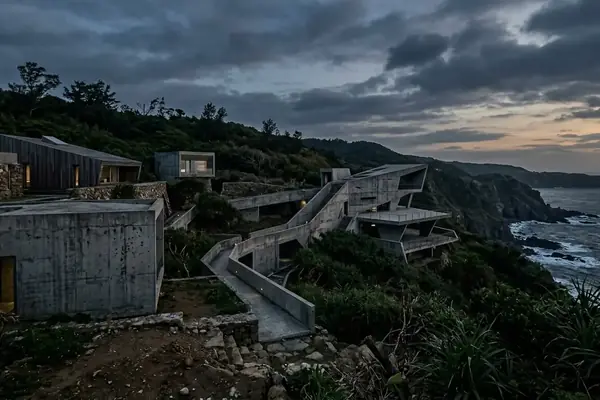
Engineers selected micro-pile foundations instead of traditional strip footings. Slender steel casings were driven directly into the substrate, allowing the structures to hover above the natural grade rather than replacing the hillside with continuous concrete.
Micro-pile diameters were restricted to in the vicinity of 150 to 200 millimeters. The structural elevation maintained circa 600 to 900 millimeter clearance above natural grade, preserving surface water movement and reducing root-zone interruption. This is not a visually dramatic tactic, but it is one of the most consequential details in the project.
Permeable hardscape with site-specific caution
Paths, courts, and limited vehicular surfaces used permeable assemblies where they supported the hillside hydrology. The goal was to slow water, spread it, and let the soil profile receive it without forcing new erosive channels downslope.
The effectiveness of permeable hardscaping varies drastically depending on the underlying clay content of the specific hillside sector. Where clay lenses reduced infiltration, the detail had to shift toward controlled dispersion rather than naive percolation. A permeable surface is not automatically ecological; it is only as intelligent as the soil beneath it.
Post-Construction Ecosystem Recovery and Monitoring
Completion is a misleading word on a sensitive site. The building may be complete, but the ecosystem has entered recovery.
Phased revegetation
The landscape architecture team structured revegetation in phases. Fast-growing nitrogen-fixing ground covers came first to stabilize disturbed soil. Slower-growing endemic species followed after the initial soil stabilization phase, which lasted 6 to 9 months, thereabouts.
This sequencing avoided the common mistake of installing mature ornamental landscapes immediately after construction. Mature planting can photograph well and fail quietly. On a recovering slope, the first task is not spectacle; it is soil grip, moisture moderation, and microbial return.
Tracking biodiversity after occupancy
Biodiversity tracking was scheduled on the order of every 120 days for circa the first three years post-occupancy. The interval was short enough to detect early decline and long enough to register seasonal change. Plant survival, invasive pressure, runoff behavior, and habitat use all informed maintenance actions.
Feedback indicates that residents accept ecological maintenance more readily when protocols are explained as part of the property’s operating logic rather than as restrictions imposed after purchase. That distinction is important in luxury settings. Stewardship must be designed into ownership from the beginning.
A maintenance framework for future projects
Map terrain, water, wind, and habitat corridors before massing studies begin.
Restrict buildable areas to landforms that require the least correction.
Set excavation and soil-displacement thresholds before pricing the architecture.
Use passive orientation and thermal mass as primary comfort systems, then size mechanical systems around reduced demand.
Preserve hydrological continuity through elevated structures, micro-piles, and carefully tested permeable surfaces.
Monitor biodiversity after occupancy with scheduled field checks, not occasional aesthetic inspections.
The larger lesson is restrained but firm. Sustainable luxury is not produced by adding ecological features to an oversized object. It is produced by letting climate, terrain, water, ritual, and structure negotiate the object from the start.