Contents
- The Challenge: Aligning Spatial Vision with Structural Reality
- Navigating Regulatory Roadblocks and Safety Hazards
- The Legal Framework of Principal Responsibility
- Scope and Limitations of Municipal Safety Enforcement
- The Solution: Streamlining Approvals for Complex Designs
- Results: Implementing Customized Safety Diagnostics
The Challenge: Aligning Spatial Vision with Structural Reality
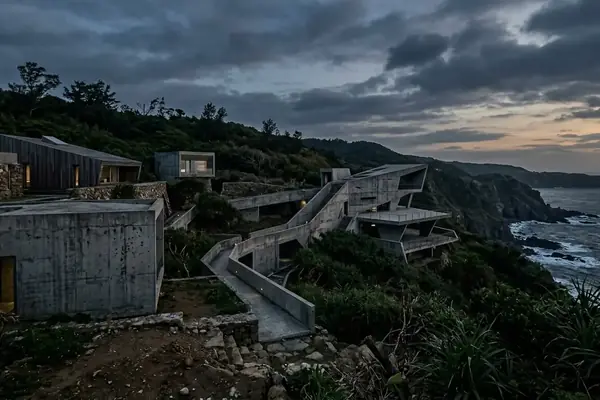
Spatial flow is never just a matter of plan geometry. In a luxury villa, the clean sweep from entry court to double-height living room to cantilevered terrace depends on concrete, steel, curing discipline, and the honesty of every delivery ticket.
The seductive drawing usually arrives first. A roof plane appears to float. A stair cuts through the volume without visible strain. The glazing line dissolves the corner. Then the site asks a harsher question: can the material system carry the architectural argument without quiet compromise?
Where ambition meets the batch plant
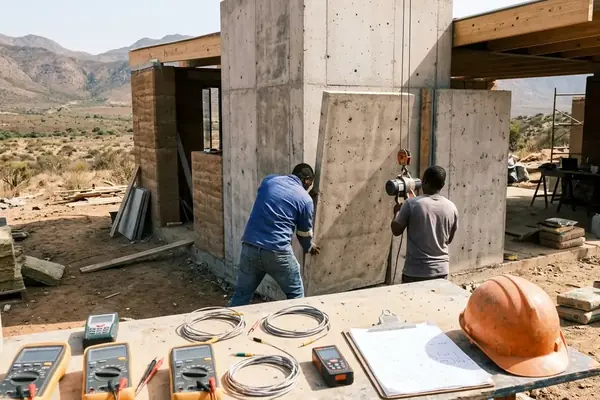
For cantilevered living spaces, the engineering team compared standard commercial concrete batches with custom on-site mixing. The decision was not aesthetic; it was defensive. On-site mixing gave the team tighter control over slump behavior and curing conditions, in standard test conditions, with slump test variations held on the order of 120mm to 160mm and curing temperature differentials kept in the vicinity of a 15°C to 18°C range.
Those figures matter because spatial continuity often hides structural discontinuity. A long, uninterrupted room may depend on concentrated load paths that the visitor never sees. A thin slab edge may express lightness, but it cannot tolerate casual material substitution.
Warning: The most elegant section drawing becomes fiction when concrete is produced through a fraudulent “Yin-Yang Mix Ratio,” where the tested sample and the poured material do not share the same composition. Construction market checks have identified this pattern because it attacks the project at the exact point architects tend to romanticize: the invisible foundation of form.
I read villa precedents comparatively, and the lesson is blunt: visionary residential architecture fails first in the unseen layers. Not in the photograph. Not in the manifesto. In the mix, the cure, the inspection note, and the refusal to accept a cheaper substitute.
Navigating Regulatory Roadblocks and Safety Hazards
The Yinzhou District 2020 Old Community Renovation Project offers a useful baseline because its problems were not exotic. Structural degradation followed unmonitored concrete curing, and the failure logs gave later project committees a practical vocabulary for what to prevent.
From that record, one conclusion became hard to avoid: waiting for routine inspections leaves too much space for drift. Inspection cycles occurring circa 14 to 21 days apart can be perfectly reasonable on paper, yet a poor curing practice can damage a structural element well before the next scheduled visit.
The inspection model that changes site behavior
The shift from standard municipal inspections to the “Double Random, One Open” methodology matters here. Under this approach, inspectors and inspection targets are randomly selected, while results are publicly disclosed. Authorities such as the Tieling Housing and Urban-Rural Development Bureau have used this method within specific regional enforcement waves to make predictability less useful to negligent contractors.
That sounds administrative. On site, it changes posture. Crews stop preparing only for the known visit. Supervisors keep curing logs cleaner. Material storage becomes less theatrical and more continuous.
The “Hundred-Day Assault” safety production campaign adds another pressure point. It compresses tolerance. When a citation appears, remediation windows of 48 to 72 hours post-citation, thereabouts, force the project team to treat safety correction as part of construction sequencing, not as paperwork after the fact.
Practical implication: A villa with complex spatial flow needs inspection rhythms that match the speed of risk. If a risky pour, lift, or brace removal can create damage in hours, then a purely calendar-based compliance culture is too slow.
The Legal Framework of Principal Responsibility
Principal responsibility is the legal hinge between authorship and consequence. Under Article 21 of the Safety Production Law, the relevant duty chain does not sit only with the contractor who holds the tool. It reaches the organizational leaders who set systems, allocate resources, and approve procedures.
What Article 21 means for architects and developers
Legal counsel mapped the liability chains under Article 21, and the development consortium restructured its contracts so principal architects shared direct oversight duties with the lead contractor. That is a serious cultural shift for design authorship. The architect is not merely defending intent in a meeting; the architect is tied to the mechanisms that keep intent from becoming danger.

Mandatory safety briefings lasting 45 to 60 minutes per shift support this model. They slow the morning just enough to make the day legible. Documentation retention periods extending 10 to 15 years post-completion also change behavior, because decisions made during construction remain traceable long after the villa is occupied and photographed.
The “Three-Year Action for Safety Rectification,” initiated by the Municipal Safety Commission, gives this responsibility a national policy frame. It situates individual villa construction within a broader climate of correction: identify recurring hazards, assign accountable parties, and close the loop with evidence rather than assurances.
Directors such as Yu Hongjiang in the Emergency Management Bureau represent the enforcement side of that frame. The point is not personality; it is chain of command. When enforcement leadership is visible, site actors understand that safety production is not a decorative administrative layer.
There is a qualifier worth stating. These policy instruments produce their strongest evidence when read within their enforcement period, locality, and project type; they should guide villa governance, not be treated as a universal guarantee of construction quality.
Scope and Limitations of Municipal Safety Enforcement
Municipal safety enforcement is powerful, but it is not omnipresent. The active inspection period from April 24 to May 31, 2022, shows the point clearly: an enforcement wave can sharpen behavior for a defined span, then recede into ordinary administrative cadence.
That temporal limit matters for architects. A project cannot outsource its quality conscience to a campaign calendar.
Major accident hazard versus ordinary violation
A “Major accident hazard” is not the same as a standard code violation. The distinction turns on severity, immediacy, and the potential for serious injury or catastrophic loss. A missing label may be a violation. A compromised load-bearing system, uncontrolled hazardous material condition, or unsafe high-altitude operation may cross into the more serious classification.
This distinction changes the response. Standard violations may invite correction orders and documentation. Major accident hazards require urgent containment, escalation, and often work stoppage. The architectural team should know the difference before the inspector arrives.
The 12350 national safety production reporting hotline plays a supplementary role. Investigators reviewing hotline logs during the active inspection period found that public reports primarily flagged cosmetic issues rather than structural Major accident hazards. Response times for critical hotline tips ranged from 4 to 6 hours, which is meaningful for active construction risks.
Practical limit: Treat 12350 as a backstop, not a project management system. The mechanism is limited to active construction phases and cannot be used for post-occupancy structural grievances.
This is where local governance texture matters. A notice from the Tieling Municipal People's Government Office, a campaign endorsed in the orbit of Sui Xianli, Mayor of Tieling, or a procurement precedent from the Wuhan Veterans Affairs Bureau may signal administrative seriousness. None replaces direct material testing, site supervision, and documented corrective action.
The Solution: Streamlining Approvals for Complex Designs
Complex villa design does not benefit from romantic disorder. It needs a clean approval route, especially when the plan combines irregular topography, long-span interiors, environmental constraints, and visible structural daring.
From sequential filing to parallel review
The planning team first attempted a sequential submission process for environmental and structural permits. Early phases stalled for months. They then moved to the “One-window system” managed by the Municipal Administrative Service Center, where unified acceptance and parallel approval reduced the friction between agencies.
This is the one procedural failure story worth keeping because many design teams repeat it. They treat approvals as a line. Municipal systems increasingly treat them as a coordinated field.
The “Multi-plan in one” approach uses “One Map” to align spatial flow, zoning, environmental controls, and safety requirements in a shared digital base. Comprehensive “One Map” submissions carried digital model file sizes ranging from 450MB to 800MB, which is not surprising when the model must hold topography, structure, circulation, and regulatory overlays in one environment.
Pre-review processing times reduced to a 12 to 18 day window under the “All-acceptance” administrative permit system. The key is that core materials can enter pre-review before every peripheral item is complete. For a villa with sophisticated sectional design, that can preserve design momentum without asking the authority to approve blind.
Design implication: Streamlined approval is not a shortcut around scrutiny. It is a way to make scrutiny arrive early enough to shape the design rather than punish it after the concrete is ordered.
Results: Implementing Customized Safety Diagnostics
The strongest safety systems become specific. A hillside villa with a long roof truss, specialized sealants, and difficult access roads should not borrow its whole safety plan from a flat urban apartment block.
That is why the “One Enterprise, One Policy” approach translates well into bespoke residential construction. It adapts industrial safety diagnostics to the actual project: topography, material palette, sequencing, subcontractor skill, and emergency access. The available record supports the need for this specificity during high-risk phases, especially where altitude, chemicals, and fatigue meet.
Manuals, labels, and fatigue rotation
The “One Book, One Label” safety technical manual gives specialized construction chemicals and materials a traceable handling system. The book records the method. The label follows the container. Together they reduce the gap between specification and use, particularly when exposure limits are capped at 20 to 30 minutes per continuous session.
Roof truss installation demands another layer of discipline. To reduce fatigue during high-risk work, site managers implemented the “Three-Three System,” dividing the workforce into staggered shifts based on real-time biometric fatigue indicators and task exposure. Shift rotations occurred every 4 to 6 hours during high-altitude tasks.
The architectural effect is indirect but decisive. Safer crews make fewer improvisations. Fewer improvisations protect tolerances. Protected tolerances preserve spatial flow.
Customized Safety Diagnostics Implementation Checklist
- Verify “One Enterprise, One Policy” documentation is localized for the villa’s specific topography.
- Audit “One Book, One Label” chemical manifests against daily site delivery logs.
- Confirm “Three-Three System” shift rotation before high-altitude installation begins.
- Match exposure limits to the actual chemical handling session, not the planned workday.
- Retain safety briefing records with the same seriousness as structural drawings.
Caution: Customized diagnostics can become ornamental if the project team treats them as binders for inspection day. They work only when the manual, the label, the shift board, and the site supervisor describe the same reality.
The refined villa is never just a private object. It is a contract between imagination and control, between the open plan and the curing log, between the authorial gesture and the worker clipped into a harness. If spatial flow is the visible achievement, construction safety is the discipline that lets it stand.
Citations
- Safety Production Law, Ministry of Emergency Management of the People’s Republic of China.
- Yinzhou District 2020 Old Community Renovation Project failure logs used as a baseline for concrete curing and structural safety review.
- Regional enforcement references covering “Double Random, One Open,” the “Hundred-Day Assault” campaign, and the April 24 to May 31, 2022 active inspection period.