Why High-Carbon Mixes Yield Lower Whole-Life Emissions on Subtropical Coasts
Specifying concrete with the highest initial embodied carbon per cubic meter is often the most reliable method to achieve the lowest whole-life carbon footprint on a warm, salt-laden coastline. When planning residential villa designs along exposed marine bluffs, material selection routinely falls victim to single-metric optimization. Project teams frequently benchmark structural mixes strictly by their upfront product-stage emissions, substituting a high proportion of Portland cement clinker with supplementary cementitious materials while maintaining conventional water-to-binder ratios. In temperate, inland contexts, that substitution lowers baseline emissions without immediate consequence. Along a subtropical coast, it invites premature structural rehabilitation.
Subtropical marine microclimates exert severe hygrothermal stress on exposed architectural envelopes. Warm ambient air holds substantial moisture and suspended sea salt aerosols. At the same time, intense solar radiation elevates the surface temperature of exposed coastal concrete. That thermal gradient accelerates two distinct transport mechanisms simultaneously: rapid evaporation of internal pore water during dry afternoon winds, and aggressive capillary suction of airborne marine mist when relative humidity rises. Alternating wet-dry cycles draw dissolved sodium chloride deep into the outer cementitious cover, concentrating salt crystals within the capillary network much faster than standard cold-water immersion models predict.
Selecting a low-clinker, higher-porosity concrete mix simply to minimize cradle-to-gate emissions ignores the kinetic reality of warm-weather ion diffusion. Elevated ambient temperatures accelerate chemical transport through saturated pore networks, driving chloride ions toward the embedded steel reinforcement cage years ahead of schedule. Once the protective alkalinity around the rebar breaks down, the resulting corrosion forces invasive structural interventions. Whole-life carbon parity must be evaluated by weighing the upfront emissions of a dense, impermeable high-clinker matrix against the cumulative footprint of a porous baseline mix plus its recurring cycles of demolition, patch repair, and protective recoating across the operational horizon of the estate.
Clinker Intensity per Cubic Meter vs. Total Structural Volume
Consider a cantilevered oceanfront terrace slab and its supporting brise-soleil screen projecting out over a coastal bluff. Under a conventional structural approach, the engineering team sizes the cantilever to accommodate both the flexural demand of coastal wind loads and the strict cover-thickness requirements mandated for marine reinforcement corrosion protection. The passive steel rebar cage requires a thick sacrificial blanket of concrete solely to delay the arrival of salt aerosols. That extra perimeter thickness adds dead weight, which in turn demands deeper beams, thicker columns, and massive subterranean foundation caissons anchored into the coastal rock.
Ultra-High-Performance Concrete (UHPC) fundamentally alters this volumetric equation by trading unit-volume carbon intensity for radical cross-sectional reduction. On a cubic-meter basis, UHPC carries a heavy embodied carbon penalty. Its formulation eliminates coarse gravel aggregates entirely, relying instead on optimized particle packing of graded quartz flour, fine silica fume, superplasticizers, and an elevated dosage of Portland cement clinker kept at a water-to-binder ratio at or below 0.20. Dispersed high-carbon steel or synthetic micro-fibers are blended directly into the paste. Because much of the tightly packed clinker remains unhydrated to act as a high-modulus micro-filler, and because metallic fiber manufacturing is energy-intensive, the baseline emissions per cubic meter exceed those of standard ready-mix concrete.
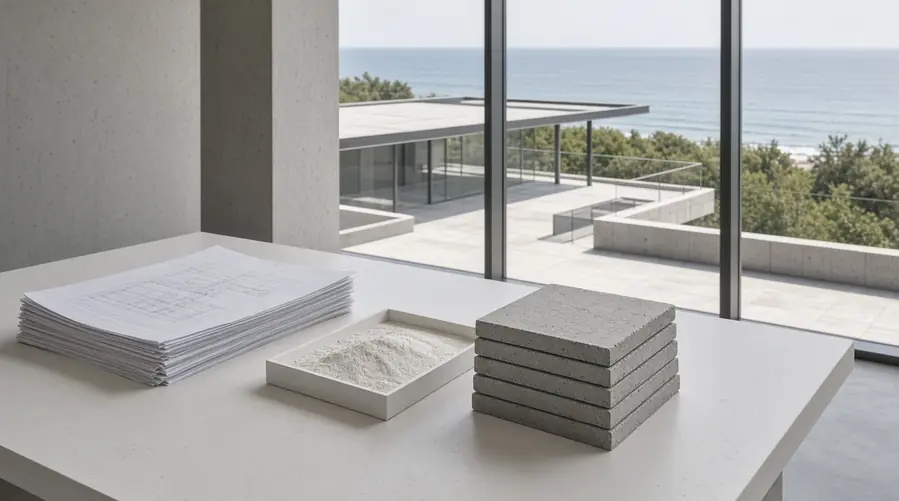
However, evaluating structural concrete by the cubic meter obscures the actual mass installed across a masterplan. The dispersed micro-fibers in UHPC bridge tensile micro-cracks directly within the matrix, imparting sustained post-cracking tensile ductility and eliminating the need for conventional passive steel rebar cages in thin shell and facade assemblies. Without a traditional rebar cage to protect from oxidation, the thick sacrificial concrete cover becomes redundant. Structural engineers can compress coastal slabs, curved roof shells, and structural fins into slender, undulating rib profiles.
In my evaluation of coastal villa geometries, the comparative math follows a three-step ratio protocol:
- Establish the Section-Volume Ratio: Calculate the total cubic volume of the conventional reinforced assembly (including mandatory marine cover thickness) against the slender UHPC section engineered for equivalent flexural and shear capacity.
- Account for Passive Steel Displacement: Deduct the embodied carbon of the dense primary and secondary mild-steel reinforcement cages eliminated by the internal micro-fiber matrix, offsetting the energy cost of the fibers themselves.
- Propagate Dead-Load Reductions to the Substructure: Compute the secondary material savings in transfer beams, columns, and foundation footings resulting from the lighter superstructure envelope.
When the product of the reduced section volume and the higher unit carbon factor—combined with the downsized foundation mass—falls below the total carbon of the bulky conventional assembly, the high-clinker mix achieves an immediate upfront carbon advantage before the building even enters its operational phase. Volumetric carbon offsetting through thin-section UHPC design does not apply to gravity-reliant substructures or acoustic mass partitions where minimum cross-sectional thickness is governed by ballast weight or sound transmission class rather than flexural capacity.
Chloride Ingress Mechanics and the Carbon Cost of Spalling Cycles
Why do conventional marine concrete mixes deteriorate so predictably even when cast with low-carbon supplementary binders? The vulnerability begins at the microscopic boundary between paste and stone. Standard structural concrete contains interconnected capillary pores created by rising bleed-water channels and porous interfacial transition zones wrapping around coarse gravel aggregates. Even when fly ash or slag refines the pore structure over time, micro-cracking from drying shrinkage and thermal expansion connects these internal pathways to the exterior surface.
In contrast, the ultra-low water-to-binder ratio and intense pozzolanic reaction of silica fume in UHPC eliminate bleed-water channels and fill the microscopic voids between cement grains. The capillary pores become completely disconnected, isolating into sub-micron voids that block capillary suction and prevent liquid or vapor transport.
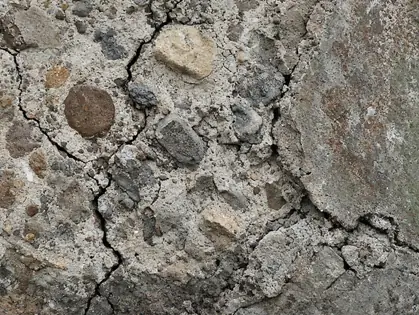
In a standard interconnected pore network exposed to warm marine air, degradation follows an relentless electrochemical sequence. Airborne and splash-borne chloride ions migrate through the capillary network until they accumulate at the depth of the carbon steel reinforcement. Once the local chloride concentration breaches the threshold of the high-pH alkaline pore solution film protecting the steel, electrochemical depassivation occurs. Anodic and cathodic zones establish along the bar, converting metallic iron into expansive ferric oxide compounds. The first outward signs appear as longitudinal surface cracks parallel to the reinforcement grid, accompanied by rust staining and hollow acoustic responses during sounding inspections that indicate subsurface delamination.
Once surface delamination and spalling begin on a luxury coastal residence, the hidden carbon cost of maintenance escalates rapidly. Addressing chloride-induced corrosion requires far more than cosmetic patching:
- Hydro-Demolition and Extraction: High-pressure water jetting or pneumatic chipping must strip away the delaminated cover and excavate behind the corroded bars to remove chloride-contaminated substrate.
- Electrochemical Stabilization: Technicians must abrasive-blast the exposed steel, splice in replacement bars where cross-sectional loss is severe, and install sacrificial zinc anodes to arrest ongoing galvanic ring-anode effects around the repair perimeter.
- Polymer-Modified Reinstatement: The excavated cavities are rebuilt using pre-bagged, polymer-modified repair mortars and volatility-prone bonding primers, which carry high embodied carbon intensities per unit weight.
- Surface Barrier Replenishment: The entire coastal facade must then be treated with penetrating silane-siloxane water repellents or elastomeric coatings, which require reapplication on regular maintenance intervals throughout the villa's service life.
Marine Envelope Alert
Applying impermeable elastomeric surface membranes over chloride-contaminated conventional concrete without first extracting the deep-seated salts traps moisture and oxygen inside the matrix, accelerating galvanic corrosion beneath the patch boundary.
How many cycles of scaffolding, hydro-demolition, and polymer patching can a coastal structure endure before its cumulative repair footprint eclipses the initial savings of a low-clinker ready-mix?
Evaluating Environmental Product Declarations Across Lifecycle Stages
To prevent premature envelope failure from masquerading as sustainable design, architectural specifications must evaluate concrete mixes across full lifecycle boundaries. Under EN 15804 and the ISO 21930 sustainability standards for building products, Environmental Product Declarations (EPDs) partition ecological impacts into distinct modules. Focusing solely on the Product Stage (Modules A1 to A3: raw material extraction, upstream transport, and manufacturing) distorts procurement decisions by omitting both delivery logistics and multi-decade durability performance.
A rigorous coastal audit requires aggregating Modules A1–A3 alongside Construction Process transport to the building site (Module A4) and Use Stage maintenance, repair, and replacement (Modules B2–B4). Comparing a cradle-to-gate declaration for a porous supplementary cementitious mix directly against a cradle-to-grave model for an impermeable ultra-high-performance mix creates an asymmetrical baseline that hides the recurring repair emissions of the lower-strength material.
Yet the lifecycle ledger does not automatically favor proprietary high-performance formulations in every geographic setting. Architects designing on remote islands or isolated coastal peninsulas must scrutinized the Module A4 transport threshold. Proprietary UHPC formulations frequently rely on pre-bagged constituent premixes, specialized quartz flours, and high-tensile metallic fibers manufactured at centralized industrial hubs. When these heavy bagged materials must travel via long-distance maritime shipping and steep coastal road freight to reach a secluded site, the Module A4 transport emissions expand rapidly. A specification shifts back in favor of locally batched ternary blend concrete—utilizing regionally sourced Portland cement, fly ash, or ground granulated blast-furnace slag (GGBS)—when the A4 freight emissions of importing proprietary UHPC premixes exceed the cumulative Module B2 through B4 maintenance and protective coating emissions of the local mix over the villa's design horizon.
| Evaluation Criterion | UHPC (High-Clinker + Micro-Fibers) | Marine Ternary Blend (GGBS / Fly Ash + Rebar) | Standard Structural Mix (OPC + Rebar) |
|---|---|---|---|
| Capillary Pore Connectivity | Disconnected sub-micron voids; blocks liquid and aerosol transport | Refined capillary network; moderate resistance to chloride diffusion | Interconnected bleed channels and porous aggregate transition zones |
| Upfront Product Stage (Modules A1–A3) | High per cubic meter; offset only when section volume is substantially reduced | Low per cubic meter due to high clinker substitution with industrial byproducts | Moderate-to-high per cubic meter combined with large cross-sectional volume |
| Site Freight Sensitivity (Module A4) | High penalty on remote coasts if proprietary pre-bagged constituents require long-haul freight | Low penalty when batched locally using regional slag or fly ash supplies | Low penalty using local batch plants and indigenous coarse aggregates |
| Use Stage Repair Burden (Modules B2–B4) | Negligible; elimination of passive rebar removes chloride-spalling trigger | Moderate; requires periodic silane-siloxane treatments and localized crack sealing | Severe; recurring hydro-demolition, anode installation, and polymer mortar patching |
Zoned Specification Protocols for Subtropical Marine Envelopes
Rather than treating an architectural masterplan as a monolithic material exercise, ecological integration demands a zoned specification strategy that allocates cementitious chemistries according to micro-environmental exposure and structural mechanics. By deploying high-clinker, micro-fiber-reinforced mixes solely where extreme cross-sectional reduction and salt immunity intersect, the design team captures durability benefits without inflating the baseline footprint of mass-governed elements.
- Zone 1: Aerodynamic Shells, Splash Zones, and Slender Facades (UHPC): Allocate ultra-high-performance mixes exclusively to thin-shell cantilevered roof canopies, wave-splash zones, exposed brise-soleil fins, and slender rainscreen facade panels. Here, eliminating passive rebar permits delicate architectural geometry that sheds dead load while remaining impervious to salt mist.
- Zone 2: Subterranean Foundations and Retaining Structures (High-Substitution Ternary Blends): Specify locally batched ternary mixes containing high proportions of GGBS or fly ash for deep foundations, basement retaining walls, and grade beams. Where soil cover shields the concrete from rapid wet-dry thermal cycling and mass is required for geotechnical stability, low-clinker mixes deliver certified durability with minimal upfront carbon.
- Zone 3: Protected Interior Thermal Mass (Low-Carbon Mass Concrete): Utilize recycled aggregate and maximum supplementary cementitious replacement for interior shear cores, acoustic dividing walls, and radiant floor slabs sheltered inside the conditioned vapor boundary.
Subtropical Site Execution and Quality Control
Even the most sophisticated zoned specification fails if subtropical placement protocols compromise the cementitious microstructure during casting. High ambient temperatures and brisk coastal winds require strict field supervision across three operational details:
- Hydration Temperature Regulation: Rich high-clinker mixes generate intense exothermic heat during early hydration. On warm coastal sites, batching protocols must replace standard mixing water with chilled water or flake ice to keep fresh paste temperatures within threshold limits, preventing thermal micro-cracking and rapid slump loss. Immediate application of continuous wet curing or high-solids curing membranes is mandatory to prevent plastic shrinkage in dry sea breezes.
- Rheological and Fiber Dispersion Verification: Before casting thin coastal shells, field engineers must verify rheological homogeneity using flow-table spread measurements. The self-consolidating paste must flow smoothly without exhibiting perimeter bleed water or central fiber clumping, ensuring isotropic tensile capacity throughout the cantilevered section.
- Elimination of Form-Tie Salt Bridges: Conventional through-wall metal form ties or permeable plastic cones must never be used in thin coastal elements. Those penetrations create direct capillary pathways that bypass the dense cementitious matrix, allowing marine chlorides to migrate straight to embedded structural connections. Specify external yolk clamping systems or non-penetrating formwork frames to preserve an unbroken envelope skin.
The physical consequence of allowing a single capillary pathway into a reinforced coastal structure is absolute: once chloride ions penetrate conventional concrete cover to reach the carbon steel boundary, the resulting ferric oxide corrosion product expands to occupy several times the volume of the original steel, turning the structure's own tensile skeleton into an internal hydraulic wedge that shatters its protective skin from within.